
“Hookers and a Camaro aren’t going to cut it anymore.” — My friend Mora
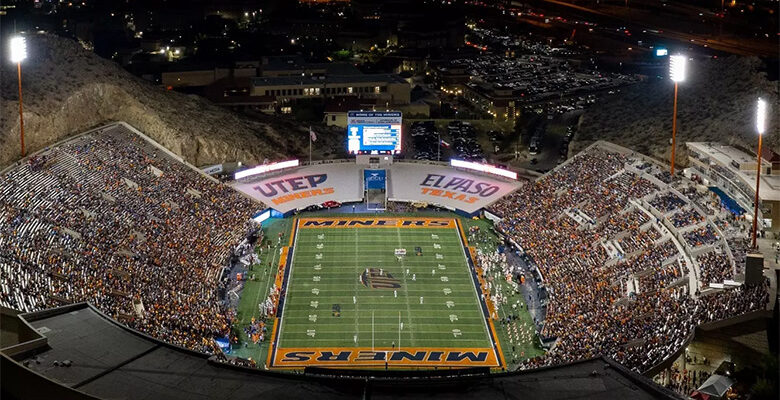
I think UTEP should be a big party school, because it’s wedged in between legal marijuana in New Mexico and an 18-year-old drinking age in Juarez. The problem is that there’s not much to celebrate at the University of Texas at El Paso. The football team went 2-10 last year, and the men’s basketball team finished eleventh out of twelve teams in Conference USA. And it’s probably not going to get any better next year.
From ElPasoTimes.com:
In this new transfer-portal, NIL era, Division I basketball teams are a revolving door of new faces looking for a pay day.
The UTEP men are taking that to its logical extreme. After an 11-20 season where UTEP finished 11th in the 12-team Conference USA and missed the the league tournament, all 12 players on the 2025-26 roster with remaining eligibility are in the transfer portal.
Since President Trump signed the Saving College Sports executive order, schools can pay student athletes a combined total of up to $20.5 million a year. College athlete is now a profession. Entering the transfer portal is like floating your résumé, except your boss, the Athletic Department, knows about it.
$20.5 million is a lot of cheddar. Of course UTEP doesn’t have that kind of cheese to spread. But, according to this story from TheProspectorDaily.com, UTEP is trying.
[Vice President and Director of Athletics Jim] Senter compared the current recruiting landscape to a high-stakes “arms race” where student-athletes no longer choose schools based solely on traditional recruitment.
“You don’t really out recruit people anymore unless you’re recruiting student athletes who are not getting paid NIL,” Senter said. “When it comes down to recruiting transfer student athletes… for the most part, that’s about money.”
. . .
The primary hurdle remains the Rev Share pool. While NCAA Division I institutions can now provide student-athletes up to $20.5 million annually, UTEP’s current resources are a fraction of that.
Last year, fundraising produced $1.1 million for recruiting and retention. Senter anticipates that number jumping to $3.45 million for the 2026-27 year, utilizing $2.3 million from the department budget to supplement donor gifts, but warned this must grow to match Mountain West peers.
Addressing questions about the record $12 million raised in fiscal year 2025, Senter explained that $8 million was dedicated to the “Climb Higher” initiative to cover conference exit fees. “Essentially, our donors helped us keep the lights on the past two years!” Senter wrote.
Here’s UTEP basketball coach Joe Golding in an article from ElPasoTimes.com:
“The first thing you look for is a 5 (a center), that’s why (UTEP’s tallest starter, 6-foot-8) Elijah Jones is in the transfer portal,” Golding said. “There are not a lot of 5s and the market is way, way up there.
. . .
“I don’t know if we have the money to go with a 5. We could Moneyball the 5 position and go get us a point guard, a scorer and a wing. Or a point guard, a scorer and a 4 (power forward). Those are the conversations we’re having with agents and with players.””If this guy costs us $500(,000) and this guy costs $300 and this guy $200, that’s $1 million we have invested in those three,” Golding said. “Then we have the rest of the money we’re building on the side.
And I guess those professional student athletes also get room and board and tuition, but I reckon if they’re making six figures, they might rent a house in The Willows. Or some kind-hearted supporter might lend them one.
But there’s always life after graduation.
Imagine being a 20-year-old college athlete making $300,000 a year. That might be more money than you’ll make the rest of your life.
If, after you graduate, or, more likely, use up your eligibility, a college basketball player might get picked up for the G League. A G League salary drops to $45,000. $45,000 for the five months that make a G League season works out to $108,000 a year, if you can find a comparably paid job for the other seven months. Not likely.
(Professors at UTEP make $143,081, on average, according to Indeed.com, and Associate Professors make $78,624. Head football coach Scotty Walden earns about $800,000, and basketball coach Joe Golding makes a little more than $700,000. That might seem like a lot, but a coaching job at UTEP may well be the end of a coaching career.)
And playing for UTEP won’t get you the exposure that you’d get if you landed at a name-brand university. You might play in a televised game on ESPN2, or some obscure cable channel, but you’ll be lucky to attract the attention of a big league scout, or get a tryout with an NBA team.
And then, after basketball?
I hope they finish their degree.