
By Kent Paterson
Paula Flores recently retold parts of a painfully long and unresolved story to an audience at New Mexico State University (NMSU) in Las Cruces-one she’s shared countless times. In April of 1998, Flores’ 17-year-old daughter Sagrario González, who worked in a Ciudad Juárez export factory (maquiladora) failed to return home to the colonia of Lomas de Poleo and was later found murdered in the Juárez Valley. As time passed more young girls and women bearing signs of sexual violence were discovered murdered in or on the outskirts of the big Mexican border city.
Confronted with official indifference and/or corruption, Flores and members of her family helped found an activist group of victims’ relatives, Voces sin Eco, which translates into “Voices without Echo” in English.
The bereaved families and their allies sounded powerful cries for justice that reverberated across nations, continents and the seven seas. Gradually, Mexico’s National Human Rights Commission, Amnesty International, the European Union, the Organization of American States, United Nations, and others issued compelling reports and policy recommendations.
Sagrario became an emblematic face in a burgeoning justice movement that transcended borders. The story of Sagrario and Voces sin Eco, was depicted in “Senorita Extraviada” (“Missing Young Woman”), the late San Francisco filmmaker Lourdes Portillo’s landmark, award winning 2001 documentary about the Juárez feminicides.
Voces sin Eco and other mother-led groups in Juárez were among the forerunners of today’s Mexican buscadora collectives, groups of relatives led by women that conduct risky searches for their disappeared loved ones (both women and men) and who also shout to the stars for justice. The buscadoras’ trials and tribulations are hauntingly familiar to many Juárez women.
Although one man has long been sentenced and imprisoned in Sagrario’s disappearance and murder, Flores lamented that justice is incomplete: the man may soon get out of prison, a possibility the Juárez mother finds unfair for someone who can just go out and “kill a girl.” And decades after the women’s murders became an international scandal, Flores is incensed that “girls are still murdered.”
While never losing sight of justice for Sagrario, Flores expanded her activism to incorporate pressing community concerns in Lomas de Poleo, a wind-swept working-class neighborhood on the northwestern edge of Ciudad Juárez that, like so many colonias on both sides of the U.S.-Mexico border, developed without basic services.
In addition to fighting for water and utility services, Flores joined in the resistance to members of the powerful Zaragoza family who claimed land Lomas de Poleo and attempted to evict residents in the early 2000s.
Lomas de Poleo was one of several mass dumping grounds of murdered women scattered around the Juárez area; the remains of eight victims were discovered there in March 1996.
“I could focus some of my pain on the necessities of the community,” Flores told the Las Cruces audience. “This helped me get over a little bit about Sagrario, because that’s all I thought about.”
Nearly three decades after Sagrario didn’t return home from her factory shift, Flores still struggles to speak about her daughter. “This might be the last presentation I do,” she said, underscoring that many of the mothers are tired, sick and unable to participate in the movement like before. For her tireless activism, Flores was the recipient this year of a J. Paul Taylor Social Justice Community Award. After nearly 30 years, Sagrario and the sweat and tears of her family are imprinted in the landscape of Ciudad Juárez and etched in the hearts of hundreds or thousands of people worldwide. A pre-school in the city is named after Sagrario.
The J. Paul Taylor Social Justice Symposium
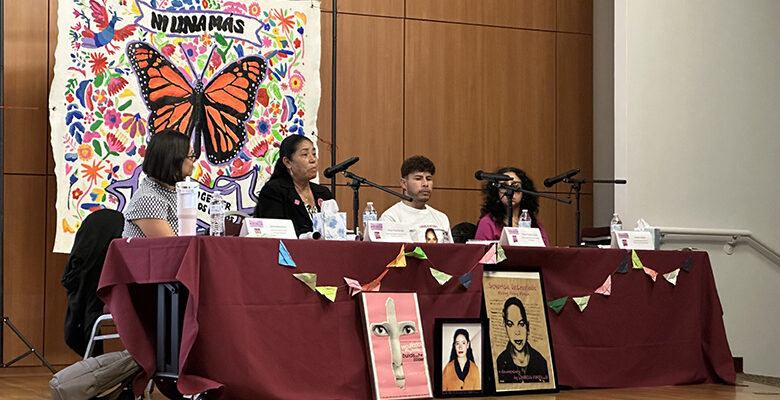
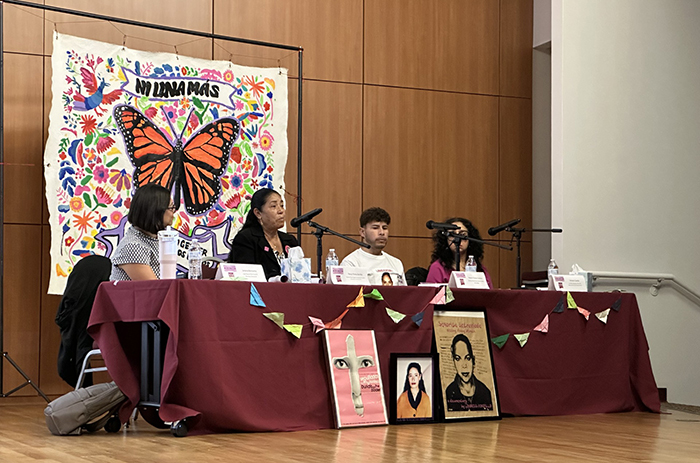
Paula Flores was among many presenters at a special 20th anniversary edition of the annual J. Paul Taylor Social Justice Symposium held last month at NMSU’s main Las Cruces campus under the theme: Ni Una Más: Standing Together Against Feminicides and Gender-Based Violence. Together with community members and experts, NMSU staff, students and faculty turned out for a two-day event that commemorated the 20th anniversary of the historic feminicide symposium held at NMSU.
Attendees heard presentations by victims’ relatives, scholars, journalists, forensic specialists, legal advocates and community activists. They watched films, talked with NMSU personnel and students staffing tables; viewed thematic artwork, listened to poetry, and sang the anthem of the anti-feminicide movement: “Ni Una Mas.”
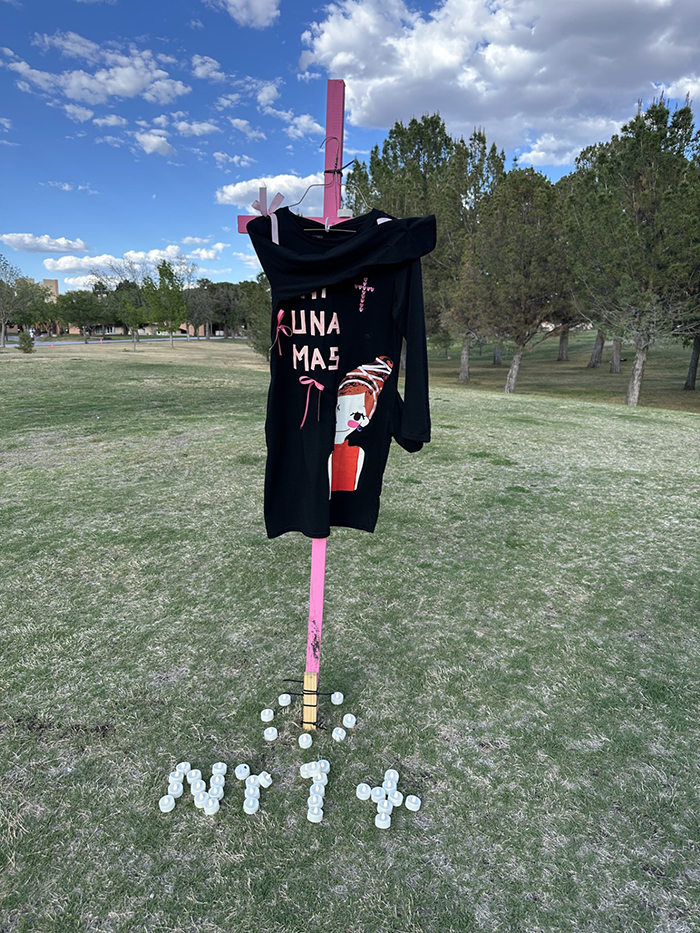
The gathering built on the legacy of the 2006 symposium which was convened when U.S. solidarity with the Juarez/Mexico feminicide victims was peaking. That event is remembered for the 200 pink crosses and dresses which were erected on the NMSU campus. Feminicide victims’ relatives from both Juárez and Chihuahua City participated in the 2006 symposium as well, delivering emotional testimonies to large audiences.
The symposium is named after a legendary educator and social justice advocate from Doña Ana County who passed away in 2023 at the age of 102. J. Paul Taylor, who served nine terms as a Democratic New Mexico State Representative, has been called” the conscience of the New Mexico Legislature.” This year’s symposium was co-chaired by Dr. Teresa Maria Linda Scholz, NMSU vice-president of the Office of Land Grant Inclusive Mission, and Dr. Cynthia Bejarano, regents professor of Gender and Sexuality Studies.
Bejarano co-founded Amigos de Las Mujeres, a Las Cruces-based that advocated against gender violence and justice for victims and family members in both Mexico and New Mexico. She was likewise instrumental in the historic 2006 symposium.
In a post-symposium interview, Bejarano said new participants such as NMSU’s Office of Land Grant Inclusive Mission were involved in the event. The feminicide scholar complemented students of the J. Paul Taylor Academy for producing “beautiful portraitures of women” for the symposium; she stressed that the symposium provided a platform to honor dedicated activists and family members who’ve “continued to raise their daughter’s cases” over many decades.
Like Paula Flores, Martin Chávez recounted the story of a loved one who suffered violent death. On June 20, 2000, his 15-year-old sister, María Elena Chávez Cabrera, left home for her job as a domestic worker but never came back alive. “We didn’t have economic solvency and she had to work,” Chavez said. “She was an adolescent full of life who had dreams,” Chávez said.
The young man recreated a torturous drama experienced by many border families: fruitless searches in hospitals, on the streets and anywhere on earth where a trace of a missing loved one might exist. Rubbing salt into the wound, the family learned that authorities discarded evidence by burning Maria Elena’s clothes, as they did with the attire of other victims.
According to the brother, family members quickly went to the legal authorities but were informed that a complaint couldn’t be filed because the legal 72 hours required for investigating a disappearance had not passed. “‘Look for the boyfriend, maybe she’s with the boyfriend'” were the official words Chávez said authorities enunciated.
Yet after the 72 hours was up, authorities still wouldn’t accept a complaint, insisting on the boyfriend explanation, according to Chávez.
Four months passed and one evening rural residents were out hunting rabbits in the community of Loma Blanca when they discovered human remains which turned out to be those of Maria Elena. The accidental find recalled a similar episode more than a half-century earlier near Las Cruces when young rabbit hunters stumbled upon the corpse of missing 18-year-old Las Cruces waitress Cricket Coogler abandoned in the desert.
Time, nationality and geography aside, the two cases are similar in that both crimes occurred when corruption eroded law enforcement and working-class women were treated as expendable. Neither case has been resolved decades later.
But Martin Chávez is one person who hasn’t forgotten. “Memory is a form of justice. Every time we say the name of a victim, we are saying something important,” he said.
Journalistic coverage of the feminicides was another topic explored by symposium panelists. Former university instructor and writer, Adriana Candia, who also contributed to the old Frontera NorteSur news service sponsored by NMSU, co-authored a seminal 1999 book on the Ciudad Juárez women’s murders that put victims and their loved ones at center stage. It was titled El Silencio de la Voz Que Todas Quiebra.
Instead of focusing on cold statistics and officials’ statements that blamed victims’ dress or lifestyles for their fates, the book humanized seven young women victims by focusing on their personal stories, dreams and aspirations. “We didn’t want to cover the voice of the mayor, the governor or parish priest,” Candia said. “We wanted to hear the voices of people who knew them.”
Candia credited Mexican writer Elena Poniatowska’s acclaimed book on the 1968 government massacre of pro-democracy students in Mexico City as influencing her approach in writing El Silencio.
Researching the book wasn’t easy, Candia recalled, elaborating on how she and her fellow authors encountered “chaos” in obtaining reliable information of victims’ lists and even names. Besides the negative stereotypes and concocted narratives aired by officials, the authors encountered unprepared police, the mishandling of crime scenes and bodies. and “tons” of recovered evidentiary clothing that just piled up and rotted away.
“It was a very shameful, sad thing,” she said. Looking back, Candia contended that the hyper gender violence which was unleased on her city impacted far beyond the individual victims and their families. “I think Ciudad Juárez was mentally ill after so many feminicides, not only the murderers but a great segment of society,” Candia mulled.
To be continued . . .
Thank you for continuing to report on the families. Memory is a form of Justice is one of the most powerful quotes I’ve heard.
I remember this as it unfolded shortly after I moved to El Paso. No one official wanted this talked about. One of my graduate school professors, an anthropologist who is an expert in ritual behavior, had been contacted by some of the unofficial investigators in Juarez who were trying to organize a conference to make the matter more public. One of them was murdered and the conference never happened. I would send him clippings from the EPT about the murders.
A movie was made about the femicides starring Jennifer Lopez and Antonio Banderas. See it if you can. It paints a pretty sleazy picture of the area, especially Juarez. EPT printed news about a group of Juarez businessmen and officials who used job ads to solicit victims who were imprisoned in that hotel near the Santa Fe bridge that is owned by the Barrio Aztecas cartel. When they were done with the girls, they would be killed. I don’t know what happened to the group.
This place is so fucking dark in its corners.
Thanks for this important coverage and keeping these families’ stories alive.