

By Kent Paterson
If the summer monsoon has been a huge letdown this year, then developments around the giant AI data center under construction in Santa Teresa, New Mexico, commonly known as Project Jupiter/Stargate, have provided plenty of stormy action. Public demonstrations, arrests of protestors and stunning legal pronouncements by the New Mexico Supreme Court all paint a story that’s emerged as a defining one for the future of New Mexico and the Paso del Norte borderland.
In one example of how the border data center issue has galvanized the grassroots, upwards of 400 people jammed the Corbett Center Ballroom at New Mexico State University in Las Cruces on the evening of August 11 for a listening session organized by four New Mexico state senators from Doña Ana County: Joseph Cervantes, Carrie Hamblen, Bill Soules and Jeff Steinborn.
The lawmakers said they had invited New Mexico state administrative agencies with responsibilities related to the 2.5 GW data center under development for Oracle and Open AI to address major public concerns over the facility’s impact on water, air, community health and the public till.
Yet the agencies in question-New Mexico Environment Department and the Office of State Engineer (water rights and permits), among others- didn’t show up for the evening.
“Yes, we are disappointed that they are not here,” Senator Hamblen told the audience.
(Back story: New Mexico Governor Michelle Lujan Grisham signed a memorandum of understanding with Project Jupiter’s Lanham Napier in February 2025 to provide robust state support for a Santa Teresa data center in return for a five billion dollar private investment for the complex, an amount which had mushroomed to $165 billion (over 30 years) by the time Doña Ana County commissioners approved two tax incentive ordinances for Project Jupiter/Stargate last September 19, thus greenlighting the development while the future operators were not even still officially disclosed.
That missing little detail was known a few days later when the Santa Teresa site was revealed as part of Project Stargate, the Trump administration’s $500 billion push to achieve AI supremacy over China. The upcoming operators in Santa Teresa were identified as Oracle and Open AI.
Four days prior to the Doña Ana County Commission’s vote, two Lujan Grisham cabinet officials, Environment Department Secretary James Kenney and Economic Development Department Secretary Rob Black, were quoted endorsing the proposed data center in a press release by one of Project Jupiter’s developers, Stack Infrastructure.)
Despite the Santa Fe no show in Las Cruces, the listening session crackled with questions and comments by dozens of county residents (nearly all of them critical of Project Jupiter/Stargate) and responses from the elected officials. As the meeting lifted off, Hamblen told a lively crowd that comments would also be accepted online.
“We are having our staff explore all of these questions and do their best to try to get answers from those (state government) departments,” Hamblen said. “And what we will do is send out a massive list of questions.”
Sunland Park resident Irene Rodriguez, who was prevented from speaking at the July 28 Doña Ana County Commission meeting, implored the four senators: “We need your help!”
Former Empowerment Congress of Doña Ana County Director Daisy Maldonado, who’s running for a County Commission seat in November’s election, elicited cheers from the crowd. Maldonado questioned the consumption of water at the Project Jupiter construction site, saying her research calculated at 227-acre feet consumed just between April and June. “That’s what I was protesting way back in August 2025,” Maldonado said.

Weighing in, Cervantes assessed Project Jupiter/Stargate as “all about money,” Soules characterized the Bloom Energy fuel cells that Oracle proposes for powering the data center as “cleaner is not clean,” and Steinborn urged stricter state environmental regulatory authority. Steinborn pointed out that the Santa Teresa hyperscale AI data center is but among three (Meta and the proposed Ft. Bliss project both in El Paso, the other two) that will impact the Paso del Norte. At least two facilities plan to employ natural gas, a greenhouse gas, in their operation.
The legacy and reality of air pollution and public health in the Paso del Norte was raised when some attendees brought up the long-disappeared Asarco smelter in El Paso which showered the Sun City, Sunland Park/Santa Teresa and Ciudad Juárez with lead, arsenic and other pollution for decades.
Senator Hamblein, who received her undergraduate education at UTEP when the smelter was still in operation, remembered a sulfuric past many once endured and haven’t forgotten. “As an undergrad, I could taste it every day,” she said. New Mexican Iliana Perez spoke about her late grandfather who worked at and retired from Asarco in the 1980s, winding up a sick man.
For Perez, who said she grew up with asthma, local air quality is both a personal and public matter. The Doña Ana County resident described her grandfather as a hardworking man who supported a multigenerational household and switched from low-paying field work to better-paying Asarco as an opportunity to get ahead in life.
Ultimately, though, a realization sunk in that smelter work was “slowly killing” the workers, Perez said in an interview after addressing the listening session. A visit to the lawyers found “(ex-workers) who were really, extremely depleted and carrying oxygen tanks, and (grandfather) just looked at me with me with fear, and we both knew what the end result would be, Perez said. “And so we spent years just watching this demise and I don’t want this to happen again…I wanted to represent him and the love and the hard work…”
Even without Asarco, the Paso del Norte is still ranked as among the worst polluted airsheds in North America by organizations such as the American Lung Association and IQAir.

More Turbulence at the Doña Ana County Commission
Hours before the New Mexico State gathering, the Doña Ana County Commission voted 3-0 to form an 11-member Community Monitoring Committee for Project Jupiter. According to the county government, the committee will consist of two members from each of the five Commission districts, with one additional member drawn from Commission Chair Manuel Sanchez’s district. Three of the five Commission members voted at the August 11 meeting: Manuel Sanchez, Susie Kimball and outgoing Christopher Schaljo-Hernandez. Gloria Gameros, who earlier announced a one-month medical leave, and Susana Chaparro were absent.
“Service on the committee is voluntary, and members must disclose any financial interest, employment or other affiliation related to any entity associated with Project Jupiter, either in support or in opposition to the Project,” the county government website states. Following an August 31 application deadline, commissioners will appoint the members.
But attendees of the August 11 meeting had mixed reactions about the Monitoring Committee. Although Project Jupiter/Stargate was again a topic of sharp public comment at the August 11 County Commission meeting, the atmosphere was far more subdued than the session two weeks earlier.
The July 28 County Commission meeting proved an especially chaotic one even by recent turbulent measures of the elected body and county government. Hundreds jammed the big meeting room at the Doña Ana County Government Center as the meeting got underway. This time the pro-data center camp turned out early and in force. Scores of building trades union members who are employed at the Project Jupiter/Stargate site, many of whom were reportedly paid to attend and transported by bus to and from the meeting, were unmistakable in their orange and yellow vests.
Rosendo Najar, president of Albuquerque-based Carpenters Union Local 1319 implored the commissioners to behold the faces of locals in the crowd who’ve landed good jobs building the Project Jupiter site. Rattling off higher Gross Receipts Tax revenues he attributed to data center construction, Najar praised the emerging facility as benefiting Doña Ana County. “Talk to every person who owns a restaurant near that project, the hotel workers…,” Najar said.
Public comments were dominated by pro-data center speakers from New Mexico and Ciudad Juárez. Plenty of opponents, however, were on hand to assert that the data center is a bad deal-economically, environmentally, socially and politically. Nonetheless, most never had a chance to argue their case.

After a little more than an hour, Commission Chair Manuel Sanchez terminated public commentary. Sanchez later explained that although two-minute time slots were allotted for 30 people, 50 people signed up speak.
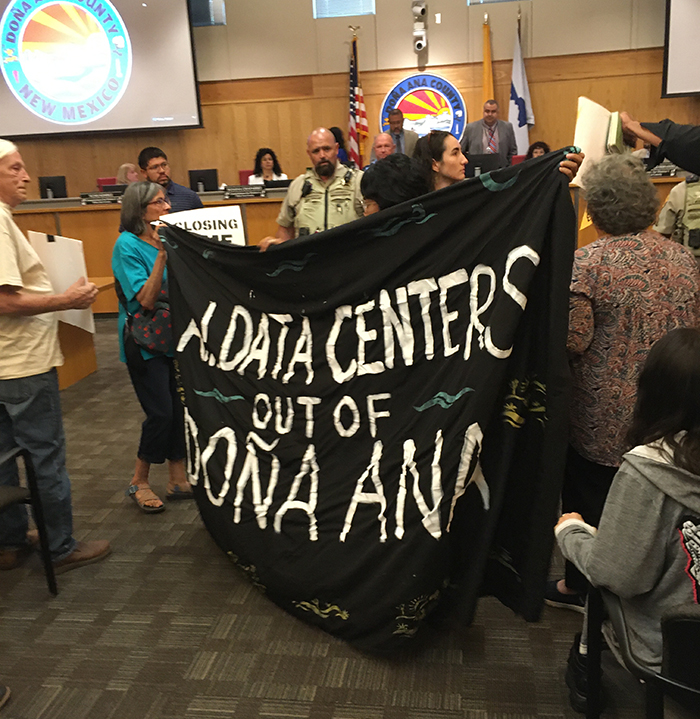
“Let her speak!” Let her speak,” shouted attendees as a woman strolled up to the dais. After she was refused the floor, a confrontation ensued involving data center opponents, sheriff’s deputies and county security guards. As temperatures outside creeped above 100 degrees the meeting melted down into shouting, shoving and swearing. The proceeding was suspended for about 20 minutes and the confrontational scenes were blanked out in the official video of the meeting.
Three protesters were arrested (one of whom was shoved to the ground by a security guard) and at least four others cited for disorderly conduct and/or kicked out of the meeting. The day’s events inspired an online petition calling for the resignation of County Commission Chair Sanchez, who’s since publicly refused to step down.
Oracle’s Incomplete Jobs Report
After many people left the meeting, a representative of Oracle and a representative of Stack Infrastructure, which is overseeing construction work, delivered a report that addressed water and energy usage as well as jobs projected for construction and post-construction activities.
Of nearly 3,000 construction workers on site, nearly 700 were New Mexico residents and close to 300 residents of Doña Ana County, according to the two men. Fourteen percent have union jobs. Though the developers pledged to hire many more locals, the current employment breakdown falls far short of the “Doña Ana County First” hiring strategy Project Jupiter legally committed to in the Community Benefits Agreement signed with the County in 2025.
Differing dramatically from previous (and shifting ) job numbers bandied about since the September 9, 2025 Sunland Park community meeting when New Mexico State Senator Michael Padilla (D-Bernalillo), who took credit for passing last-minute legislation in early 2025 that facilitated Project Jupiter/Stargate, estimated 4-6,000 total jobs (with secondary investments), Project Jupiter reps at the July 28 meeting informed that a peak of 7,000 construction jobs and 1,500 various “ongoing” positions would now be needed.
Questions about local hires intensified earlier this year when Doña Ana County officials acknowledged that Project Jupiter developers had not filed quarterly reports with the county. Though a quarterly report was finally expected to be delivered at the end of last month, a July 28 request by the reporter to the county government for a copy-if such a report exists- has not been answered.
Of note, Stack Infrastructure, the global company overseeing the Santa Teresa construction, was the recent recipient of a New Mexico Training Incentive Program grant of $3,056,745. According to the New Mexico Economic Development Department, the money will fund 95 trainees in AI related infrastructure skills, at an average hourly rate of $48 per hour.

Jupiter Casts Long Shadows in the Dog Days of Summer
On Friday, August 21, more than one hundred people organized by Youth United for Climate Crisis Action and others demonstrated against Project Jupiter outside New Mexico Environment Department headquarters in the New Mexico state capital of Santa Fe.
Then on Monday, August 24, New Mexico and national media buzzed with news of two unanimous weekend rulings by the New Mexico Supreme Court that granted emergency stays affecting the development. First, in a case brought by Santa Fe-based New Energy Economy, justices threw a wrench into NMED plans to conduct a Sunland Park public hearing September 14 for Project Jupiter’s still missing air quality permit, granting a stay in the process.
The ruling was the latest twist in a confusing process that began with NMED originally setting an October hearing date but then moving it up to September after an intervention by developers. The New Mexico Environmental Law Center (NMELC) which represents Sunland Park and Santa Teresa community members, slammed the switcheroo.
While the October hearing date “gave the community more time to gather technical testimony and prepare for the hearing,” the September date constituted “completely inadequate time to prepare technical testimony,” the environmental advocates said.
Although developers contend that the Bloom Energy fuel cell technology they plan to utilize is environmentally friendly and a great improvement over initial plans to power the data center with natural gas fueled turbines, critics say the fuel cells will still use natural gas and emit a significant variety of air pollutants and climate altering greenhouse gases, with the latter even possibly rivaling emissions from New Mexico’s largest cities.
In a second case filed before the Supreme Court, the Center for Biological Diversity (CBD) obtained an emergency stay to stop a water diversion to Project Jupiter. The CBD contended that the New Mexico Office of the State Engineer did not follow proper procedures when it granted an emergency authorization to Santa Teresa Capital for drilling a replacement well to supply water necessary for Project Jupiter’s construction.
According to the CBD, more than 103 million gallons of water have been pumped from the new well since April. Moreover, construction is expected to continue for two more years, according to the July 28 Oracle-Stack Infrastructure presentation.
“The water order is narrowly written. It stays the emergency drilling authorization and the use of water from that new well for construction,” wrote Damien Willis of the Organ Mountain News, a small media outlet which has followed the data center drama with the nose of a news hound. “It does not, on its face, order all Project Jupiter construction to stop or suspend every water-related approval associated with the development.
The volume of water extracted from the well greatly exceeds the amount agreed to by developers and Doña Ana County officials in the Community Benefits Agreement signed by the parties which limits water consumption for operational uses to between 20,000 and 60,000 gallons per day, numbers widely used by development promoters. However, the legal agreement fails to stipulate water requirements for construction purposes, which until now has been tapped from the transborder aquifer shared by Sunland Park, Santa Teresa and part of Ciudad Juárez.
“Freshwater is New Mexico’s most limited and precious resource,” said CBD attorney Colin “We have robust state laws to protect our water that have been blatantly violated. The Supreme Court has a duty to step in and enforce the law.”
For now, both the air and well water permitting for Project Jupiter are paused until the New Mexico Supreme Court further considers the cases. In yet another Monday jolt, it was announced August 24 that the hearing officer in the pending September 14 Sunland Park air quality permit hearing, Max Shepherd, had recused himself. Last week, the CBD and NMELC filed an emergency motion to disqualify Shepherd on grounds of bias and favoritism which, according to NMELC Senior Staff Attorney Maslyn Locke “would have made a fair hearing completely impossible.”
Not surprisingly, Oracle strongly disagreed with the legal decisions that struck like an August thunderclap. In a statement to El Paso media outlet KVIA, the high-tech company repeated almost verbatim the employment, tax revenue, water consumption and air pollution emissions numbers it had presented at the stormy July 28 Doña Ana County Commission meeting, contending that local benefits were materializing and ongoing commitments to the environment were holding steady, including a pledge to enlist “100% carbon-free energy by 2031.”
“The effort to bypass (NMED’s) established procedural deadlines is unwarranted, but we will continue to share facts about the project transparently and are confident the regulatory process will prevail…,” Oracle was quoted. “We will of course comply with the (legal) order and remain focused on long-term water stewardship..”
Santa Teresa resident and Project Jupiter opponent Vivian Fuller, however, had a different take on the data center’s August. “As a community, this brings hope and unity, letting these Big Tech companies know that we will continue this fight,” Fuller said in a statement issued by the NMELC. “We will not let them reshape our energy system, water, and climate to their benefit and liking.”
As Senator Hamblen remarked about Project Jupiter at the August 11 NMSU meeting, “I think trust is gone.” On a similar note, a onetime prominent project supporter, New Mexico State Representative Sarah Silva (D- Doña Ana), penned a stinging op-ed published August 24 in El Paso Matters.
“I am writing to invite the developers of Project Jupiter to abandon their plans, pack their things, and leave Doña Ana County for good,” Silva wrote. “I’m serious. As an early supporter of this project because of the jobs and infrastructure it promised, I’m fed up with the dishonesty, broken promises and threats.” According to Silva, “”The final straw for me is Oracle’s recent suggestion that it may try to connect Project Jupiter to the El Paso Electric grid. A company official first suggested this publicly in June and spun it as a good thing for us. (It is not)…”
Looking ahead, New Mexico State Representative Micaela Lara Cadena and other lawmakers plan to introduce legislation during the 2027 legislative session that would impose a moratorium on data center development in New Mexico. Meanwhile, Project Jupiter developers are ramping up their public relations campaign with a new round of ads tailored for radio and Pandora.
By the reporter’s count, at least eleven legal actions have been pursued or are possibly pending on Project Jupiter related matters, including several against the Doña Ana County Commission on matters ranging from legal procedure to public transparency.
As a backdrop to the thickening drama surrounding Project Jupiter/Stargate, the climate crisis galloped on unimpeded in the sizzling summer of ’26.
North of Doña Ana County, New Mexico’s Elephant Butte Reservoir, which provides agricultural, recreational, industrial and residential water to the binational Paso del Norte, hit a new low, prompting the small City of Elephant Butte to declare a local disaster.
“2026 is the driest year on record through July. Last winter’s snowpack failed, the hottest March ever measured melted it early…,” wrote Norm Gaume on newmexicowateradvocates.org. “Elephant Butte Reservoir is 1.3 percent full, with 27,000 acre-feet..”
Dry skies were the norm as windstorms replaced rainstorms. Leaving the NMSU Corbett Center meeting, attendees found their parked cars covered in dust from a bizarre wind blast that had zoomed in and out by the time the event was over.
Perhaps in a fiery flash symbol of market and fossil fuel driven climate fiascoes, the reporter ran across a semi-truck pulled off on the shoulder and on fire on Interstate 25 during the afternoon of August 11. Burning about 15 miles north of Las Cruces, the big rig spouted flames and belched black smoke into the path of motorists as chaos enveloped the dusty desert highway overlooking the ancient river valley where the withered Rio Grande begs water.