by Bob Chessey
(Unless otherwise noted, information is based on March 2, 2010 interview by author with retired El Paso Police Detective Ed Agan)
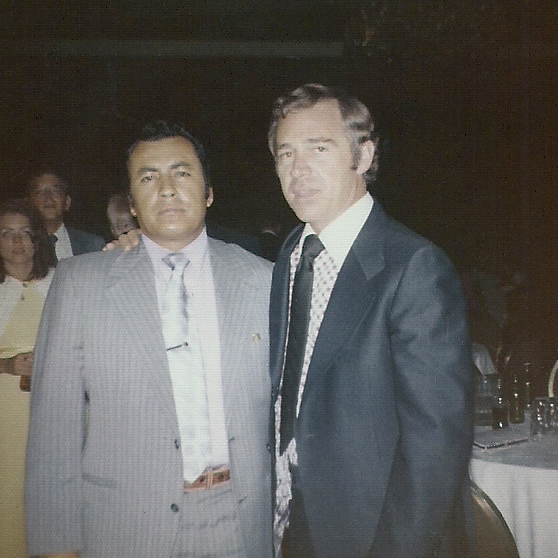
On the afternoon of Monday, October 4, 1965, El Paso Police detectives Edward Agan and his partner Armando Nava were driving downtown along El Paso Street when they noticed a thin Anglo man dressed in black standing in front of, and staring intensely, into a pawn shop’ plate glass window displaying pistols. The stranger’s appearance, long hair, black silk suit lined with black velvet on the collar and cuffs, and black ankle boots, triggered both officers’ instincts that they were looking at a questionable ex-convict.
Agan and Nava parked their unmarked car, approached the suspicious window shopper, one on each side, flashed their badges, and asked him for identification.
Annoyed, the oddly dressed man slowly looked at the detectives one at a time, reached cautiously with one hand into his inside jacket pocket, removed a billfold and let the elongated accordion plastic photo/ID holder, full of credit cards, driver license, etc., slowly unfurl. They all read either John R. Cash or Johnny Cash.
With the ID prompt the two officers recognized the country star and explained their suspicions had been aroused by his looking at the guns in the pawn shop window. Cash’s attitude shifted to friendly and he explained that he collected antique Colt pistols and made it a habit to look in the pawn shops of the towns he passed through hoping to get lucky and come across one. Having some time before he had to catch a plane later that evening he was exploring the downtown pawn businesses.
Officer Agan recommended that the singer visit a nearby gun business as the proprietor was selling an old Colt previously owned by a famous person with a letter of authenticity.
Cash gratefully thanked him for the promising tip and stepped off in the direction of the shop. (Agan remembered that Cash did purchase the vintage six gun though he could not recall who had previously owned the Colt).
After Cash walked away to track down his lead on the gun, Agan and Nava decided to drive to the downtown international bridge which, in 1965, was located not on El Paso Street but at the foot of Santa Fe Street.
At the time, people who had been convicted of a narcotic crime who visited Mexico were required to record their name on a Customs form at the port of entry before leaving, keeping a carbon copy of the form with them, and when returning from Mexico hand in their copy to a Customs officer. If a returning convicted person was found to have failed to register, they would be arrested, even if not in possession of drugs. However, when a person was found to have failed to sign in, but not in possession of prohibited drugs, at times the violator would be offered the opportunity to provide information in exchange for not being arrested.
Agan and Nava’s drove to the bridge to check if they recognized any addict returning from Juarez who had failed to register. The wait did not last long. The officers confronted the offender and explained he had the option to be released if he could give up worthwhile information on anyone he had noticed when he was at Juarez heroin Queenpin Ignacia “La Nacha” Jaso de Gonzalez’s picadero. A picadero is the Spanish term for a “shooting gallery, being a location that sold narcotics, often provided multiply reused hypodermics and needles, and allowed the user to inject their drug purchase.
The man replied that he had nothing to give up, but, feeling his back up against the legal wall, he offered that he had noticed an unfamiliar and strangely dressed man in black in Juarez buying lots of pills not far from the picadero. He described the fellow as having long black hair, wearing a black suit with dark velvet highlighting the collar and cuffs, white shirt, and black ankle boots.
Agan and his partner turned and looked at each other. Their informant was free to leave.
Though local lore often places Cash’s arrest after his Juarez “shopping” trip at the international bridge into El Paso, the county icon was not apprehended at the Port of Entry.
Realizing that by the time it would take to secure a search warrant from a judge that Cash would have already flown out of town, Nava and Agan took advantage of US Customs agents authority to stop and search in a limited border area without a warrant, and that the airport stood within that jurisdiction. The detectives explained the situation to Customs officials and handed over the investigation to them.
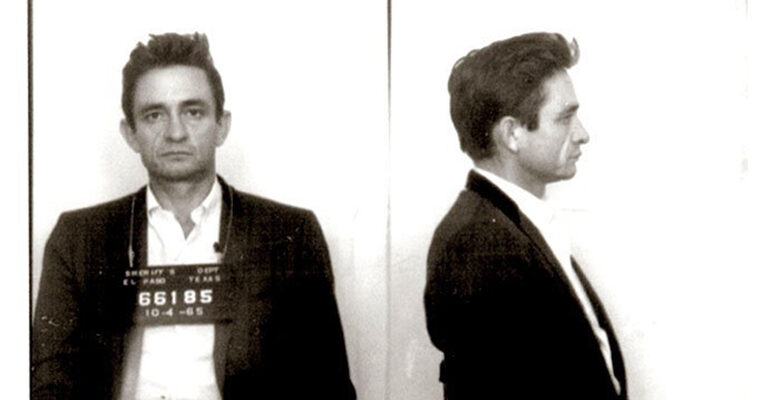
After arriving at the El Paso Airport and making their way to the correct departure gate the Customs agents found Cash, identified themselves with badges, and escorted the Man in Black and his luggage to a separate room. Searching inside his guitar case the officers discovered a cache of 668 Dexedrine and 475 Equanil tranquilizers. Cash was placed under arrest at the El Paso International Airport at approximately 7 pm, booked downtown, and spent a long night in the El Paso jail that would leave a lifetime scar across his memory.i
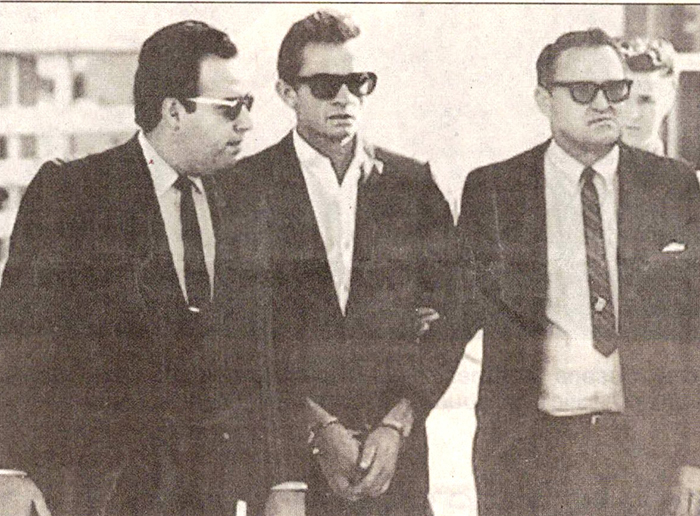
The following day Cash was taken from the jail in handcuffs, placed on display in a perp walk, stood before U.S. Commissioner Colbert Coldwell for charges, and posted a $1,500 bond allowing his liberty until his late December arraignment.The man who had promised to walk the line found himself facing up to a year in jail and a $1000 fine.
Three days after Christmas, Tuesday, December 28, 1965, Johnny Cash was arraigned in U.S. District Court before Judge D. W. Suttle. Cash, tanned and several pounds heavier than when arrested, was accompanied by his first wife Vivian and his El Paso attorney Woodrow W. Bean. Also sitting next to Cash was Det. Ed Agan, who remembered that at the hearing the famed western star was very friendly towards him.
The man in black pled guilty to possession of illegal drugs.
When Judge D. W. Suttle questioned the defendant as to where he had purchased the pills, Cash answered that he had bought them on a street in Juarez, Mexico.
Judge Suttle made the decision to continue Cash’s $1,500 bond and defer sentencing until the jurist had received and reviewed a report on the singer’s case from U.S. Probation Officer Chester McLaughlin.ii
Cash had just completed a three-week tour in Ohio and Michigan when he arrived at the El Paso courthouse for his March 8, 1966 sentencing trial. Accompanying the defendant were his attorney Woodrow W. Bean; Don Law, vice president and recording agent for Columbia Records Nashville office; and Reverend Floyd Gresset of the Avenue Community Church in Ventura County, California.iii
Reverend Gresset testified that he believed Cash was really trying to turn his life around.
Judge Suttle acknowledged that the U.S. Probation Office’s report that had been delivered to him contained multiple testimonials on Cash’s behalf. Submissions in the report included the Department of Defense recognizing the performer entertaining military personnel, his having been awarded a good conduct medal while serving in the US Air Force, as well as letters of support sent from western recording stars including Gene Autrey and Tex Ritter.
On the witness stand Cash revealed that before his October arrest he had just completed a string of one-night stands and decided to visit Juarez to unwind, “I realize my mistake,” Cash confessed. “It was bad, very bad, misconduct on my part. I had several beers. I guess I was so tired I lost my faculties. I saw the customs agent staked out on the corner, but I just didn’t seem to care.”iv
While touring through the early years of his career Johnny Cash had become addicted to uppers and downers, the more likely motivation to fly to El Paso was to intentionally purchase a supply of pills in Juarez.
When Cash was asked by Judge Suttle if he chose to make a statement on his own behalf, the remorseful accused replied, “I only would like to say that I ask for leniency from the court. I know I have made a terrible mistake and I would like to be free to go back to rebuilding that image that I had before this happened.”v
Judge Suttle ruled Cash guilty to the misdemeanor charge of possession of illegal drugs with a fine of $1,000 and a 30-day suspended sentence.
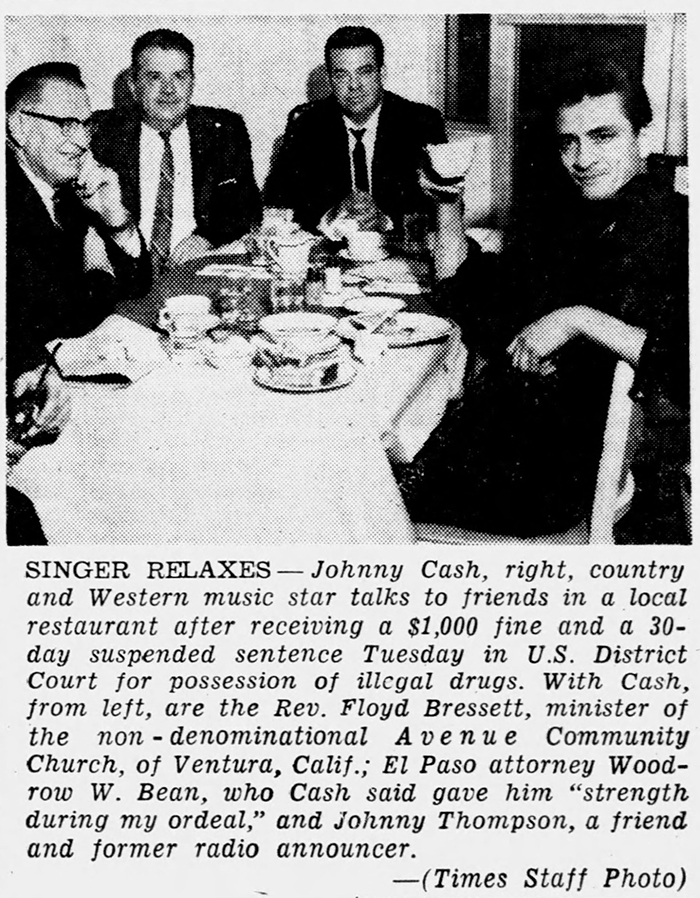
Following his trial, Cash celebrated his verdict at a local restaurant with an indulgent breakfast of four-minute steaks, scrambled eggs, a stack of hot buttered toast, and multiple cups of coffee. Joining the relieved singing songwriter were Rev. Bressett, Woodrow Bean, his friend Johnny Thompson, and Don Law from his record label.
In 1972 Cash’s El Paso arrest again made the news when the recording artist testified before a US Senate prison reform subcommittee and the singer went on record admitting, “That one night in jail at El Paso was tough.”vi
Johnny Cash’s 1965 arrest was not the most important drug case in El Paso history, but certainly has become the city’s most famous drug bust.
i “Singer Nabbed in Pill Smuggling,” El Paso Herald-Post, Oct. 5, 1965, p. 1; “To Arraign Western Star Tuesday,” El Paso Times, December 28, 1965, p. 1.
ii “To Arraign Western Star Tuesday,” El Paso Times, December 28, 1965, p.1; “Cash Enters Guilty Plea Before Suttle,” El Paso Times, December 29, 1965, p. 1.
iii Loretta Overton, “Sweet Notes Follow Sour: Cash Sentence Suspended, El Paso Herald-Post, March 8, 1966, p. 1; “Judge Suttle Fines Cash $1,000,” El Paso Times, March 9, 1966, p. 1.
iv “Judge Suttle Fines Cash $1,000,” El Paso Times, March 9, 1966, p. 1.
v El Paso Herald-Post, March 8, 1966.
vi Sarah McClendon, “Johnny Cash Testifies About Night In EP Jail,” El Paso Times, July 27, 1972, p. 15.