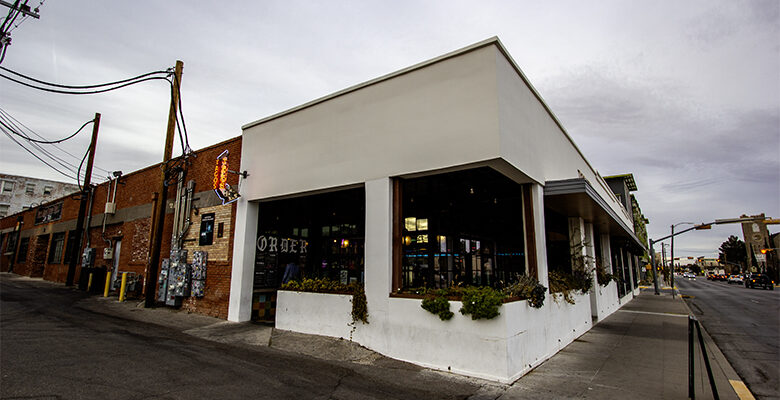
For the third year in a row, Taconeta made it to the semi-finals of the James Beard Awards in the category Outstanding Wine and Other Beverages Program.
According to JamesBeard.org, the award is given to:
A restaurant that demonstrates exceptional care and skill in the pairing of wine and other beverages with food. This includes the selection, preparation, and serving of wine, cocktails, spirits, coffee, tea, beer, or any other beverage with outstanding hospitality and service that helps inform and enhance a customer’s appreciation of the beverage(s). Ethical sourcing will also be considered.
Taconeta has a very limited bar. The focus is on Mexican spirits. The only real bourbon they stock is the almost-impossible-to-get Blanton’s. For vodka, they only carry Tito’s. Other “non-native” spirits are also similarly limited.

They do have, however, a broad selection of Mexican spirits. Eccentric spirits, like an unusual rhum agricole called Charanda, from the Mexican state of Michoacan. A liquor made from heritage corn with the brand name Abasola, from a pueblo magico in the state of Mexico.
Taconeta also offers a wide range of what are generally referred to as “cactus spirits,” even though no cactus is ever actually harmed in their production.
Tequila and mezcal are made from magueys, which are not, taxonomically, cactus. Sotols are made from a Chihuahuan desert indicator plant, which, in English, we call by the imaginative sobriquet “sotol”. Sotol is also not a cactus. In El Paso, sotols are a popular decorative yard plant. In Spanish, they call the plant sereque and the spirit sotol. Sotol the spirit has a restricted Denominación de Origen (production area) close to home, limited to the Mexican states of Chihuahua, Coahuila, and Durango. Some Americans in Texas and New Mexico are making sotol in contravention of the norms.
Taconeta offers about a dozen expressions from sotoleros, including one that was distilled with venison and another distilled with rattlesnake. There are a similar number of mezcals, including a tincture of lemongrass.
At Taconeta, a curated selection of tequilas dominates the rest of the back bar. There are a half dozen silver tequilas on the shelf. (In my opinion, silver tequilas are the most honest expressions of the distiller’s art.) And about six each of Reposados and Añejos, and on the lofty highest shelf, an Extra Añejo whose cork had been dipped in black wax and probably costs a dollar just to look at. I snuck a peek.
Taconeta isn’t one of those bars that offers every brand of tequila in every flavor and presentation, some place that overwhelms and underwhelms at the same time. You don’t have to know about tequila, or mezcal, or sotol, to drink at Taconeta, because someone else has made all the hard decisions for you. A connoisseur selected the spirits that fill the back bar at Taconeta.
Taconeta also features a changing seasonal rotation of Margaritas, including, as I write this, a Mezcal margarita that includes carrot juice.
The beers are Mexican or local, and the wines natural.
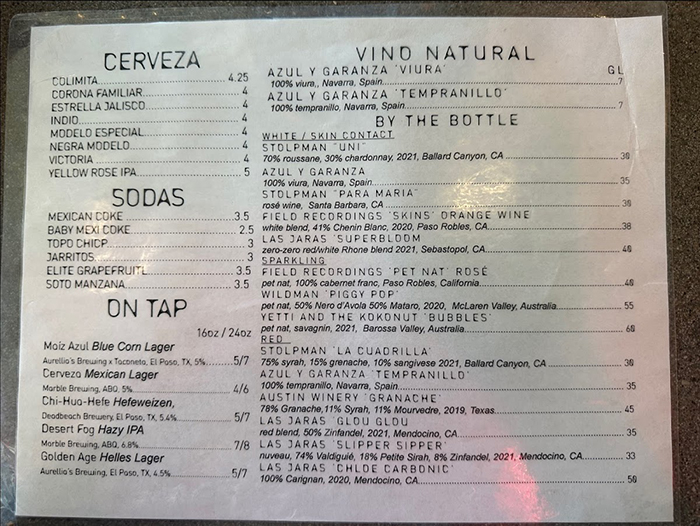
I had to look up “natural wines”. Here’s what Google AI told me:
Natural wine is wine made with minimal human intervention, using organic/biodynamic grapes, native yeasts for fermentation, no synthetic additives, minimal or no added sulfites, and often bottled unfined/unfiltered, resulting in diverse, expressive wines that reflect their origin, though definitions vary, focusing on transparency and purity over industrial methods.
It sounds like what your grandma used to make, when she was a hippy in a tie-dye t-shirt living in a travel trailer on a goat farm in Idaho. (Ask her about that, but don’t tell her that I was the one that ratted her out.)
Oh yeah. The restaurant also serves food. Particularly tacos, and after you blow through the liquor selection you probably need something to eat. The menu’s a la carte, and the tacos are not your typical fried shell picadillo tacos a la Taco Bell or that mom-and-pop little hole in the wall I’m never going to quit. The soft tortillas are made from heirloom corn which has been nixtamalized in-house. Nixtamalization is a process that involves the introduction of lime (calcium carbonate or calcium oxide) to the corn, to make more nutrients digestible. How the hell did early Americans figure out that they needed to add lime to the corn? I found a clue in the etymology. The word nixtamalization comes from two Nahuatl words, nixtil, which means ashes, a tamali, which means masa. Wood ash contains lime. Maybe throwing a little wood ash on that corn mash was just intuitive. Maybe the knowledge was genetically encoded. It was a nutrition leap akin to sliced bread, or pasteurized milk, or cooked meat. Really, who knew?
Taconeta is a good place to eat small. A couple of tacos and a beer and you can get out of there for $15 plus tip.
On recent visit, I caught the actress Riley Keough taking a double order of the Green Beans Tempura home to her husband back in El Lay. That’s true love.
Taconeta is popular. At peak hours you might have to wait for a table. Sometimes parking is difficult, but the restaurant is only half a block from a trolley stop, and there’s street parking if you work for it.
Taconeta was born during the pandemic, and some of the systems developed then have been retained. At Taconeta, the customer orders at an outside window and then takes a number lollipop to their table where their food soon arrives. Pro Tip: If your party is small, I’m sorry. But as a consolation, you can skip the line and go right to the bar, and order food and beverages directly from the bartender.
Taconeta is oddly sophisticated. Taconeta is high concept. Taconeta is fine dining on the down low. Paper boats and plastic cups and numbers you carry to your table so your order can find you. The decor is plywood and naked duct work. But there’s also original artwork and relevant commissioned art and decorative brick, and a poppy upbeat Spotify playlist. Taconeta is intuitively elegant without being pretentious.
And three consecutive years of James Beard Award semi-finalist recognitions for an Outstanding Wine and Other Beverages Program validate their plan.
Other local semi-finalists in James Beard categories were Danny Calleros, at Ardovino’s Desert Crossing in Sunland Park, for Best Chef: Southwest , Andres Pablos, at Accá, in almost downtown El Paso, and also Gabe Padilla and Melissa Padilla, for their work at Café Piro, in Socorro, for Best Chef: Texas.
Congratulations to all four, or five, and best of luck in the next stages of the awards process.