Have you noticed something about El Paso weather lately, as in the past few years or so? I have. It is always “unusual.” It is unusually hot, unusually dry, unusually warm for October, unusually warm at night, or we are breaking another record for something we apparently didn’t know needed a record. Then there are the stronger-than-normal monsoons (the recent wet spell we had was partially attributed to the “monsoon.” Okay, but a monsoon in late September?) the droughts, the dust storms, and, every once in a while, one of those enormous walls of dirt comes rolling across the desert and we get to use the wonderfully exotic word “haboob,” which apparently gives everyone on the local news a middle school chuckle. Say it with me, Michelle: “Haboob.” The weather is unusual.
How long can unusual weather remain unusual before it becomes the weather? More importantly, at what point do those people standing in front of the weather map every night stop telling us that something unusual happened and start explaining why so many unusual things keep happening?
I ask because television meteorologists occupy a rather unique place in our lives. For many people, they are probably the closest thing they regularly encounter to a working scientist. Not somebody appearing in a PBS documentary or being quoted in a newspaper article, but a real, live scientist who comes into the living room several times a day and talks about atmospheric pressure, humidity, wind, radar, fronts, dew points, and why that big green blob over Las Cruces may or may not ruin Saturday’s cookout. We trust them to take some fairly complicated science and translate it into something the rest of us can understand. Doppler Dave (KVIA) has a Master’s degree. Robert Bettes (KTSM) has a degree in Atmospheric Physics and has the Certified Broadcast Meteorologist (CBM) Seal of Approval from the American Meteorological Society. Brad Montgomery has a degree from Mississippi State. That is a lot of science learning standing in front of the green screens and giant LCD panels.
We pay attention. Someone in the know at one of the local stations once told me that audiences turn to the local news for the weather and not much else. We get weather at the beginning, weather in the middle, weather before the commercial, weather after the commercial, and weather at the end. “Coming up, Doppler Dave will tell us if that cold front is really going to cool things down this weekend.” Apparently, he knows something we need to know, so don’t touch that remote. And he might just say “haboob caused by backdoor high pressure,” which sounds kinda dirty. Gone are the days when the local weatherman doubled as Bozo the Clown, had to grab your attention with Puffy the Weather Dog, or called your wife at noon while “Dialing for Dollars,” and the weather was something quickly sandwiched between the news and the sports. Nope, weather people are qualified to do the science of weather, and weather takes up a huge percentage of the 30-minute broadcast. Maybe that’s why Doppler Dave has his own “Weather Lab” where he can experiment on the weather without our knowledge, making life better for the chickens on his “Chicken-Cam” (sponsored by Mattress Firm). The main weather segment alone can take up more than 10 percent of an entire half-hour newscast and around 15 percent of the actual noncommercial airtime. Add the weather teases, the “First Alerts,” the “4-Warns” the quick updates, and additional forecasts scattered through the broadcast, and weather occupies an extraordinary amount of local television’s most valuable real estate.
That popularity gives television meteorologists something most scientists would kill for: an audience that actually wants to hear them talk about science. Scientists spend enormous amounts of time trying to convince the public that science matters. Meteorologists don’t have to. We voluntarily tune in and ask them to explain the atmosphere to us every single day. That seems to me to come with a responsibility that goes beyond telling me whether I need a sweater tomorrow morning, or I can wash my car (sponsored by Mister Car Wash with 200 convenient locations around town).
Explain what is happening to our climate. Explain it without politics, without ideology, and without worrying whether the explanation makes Republicans angry, Democrats happy, Democrats angry, Republicans happy. Tell us what the evidence says, what it doesn’t say, and where scientists are uncertain. In other words, do what explainers, teachers, are supposed to do.
The NWS has been keeping records in El Paso since the 1800s, which means we don’t have to rely on somebody saying, “Well, I’ve lived here my whole life and I remember it being hotter in 1972.” Maybe it was hotter one afternoon in 1972. That’s weather. Climate is what happens when we take all those afternoons, nights, months, and years and start looking for patterns, and when we do that, the El Paso numbers get pretty interesting.
NOAA periodically updates what it calls “climate normals.” It takes 30 years of weather and says, more or less, “This is normal.” For years our normal was based on 1981 through 2010. Then NOAA moved the window forward ten years and calculated a new normal using 1991 through 2020. El Paso’s average annual temperature went up 1.6 degrees.
1.6 degrees doesn’t sound terribly impressive. We are talking about changing the average of thousands upon thousands of temperature readings collected over decades. Even more interesting is where much of that warming occurred: El Paso’s average daytime high increased by about half a degree, while the average nighttime low increased by about 2.7 degrees. Our nights are getting warmer.
Some of that change may be El Paso itself. We have spent decades replacing desert with houses, streets, parking lots, shopping centers, and concrete, and all of that stuff absorbs heat during the day and releases it at night. But El Paso isn’t the only place getting warmer.
We always had 100-degree days. This is the desert. What has changed is how often those days occur, and that is where the numbers become difficult to ignore. During the 1970s, El Paso averaged about 18.5 days each year at 100 degrees or hotter. During the 1980s it was about 19.6, in the 1990s about 21.2, and during the 2000s about 20.7. Notice that those numbers don’t march neatly upward every decade, and that’s important. Climate doesn’t work that way.
Then we hit the 2010s and the average jumped to about 33.6 days. From 2020 through 2024, it was more than 47 days a year. In 2023, El Paso experienced 70 days at or above 100 degrees and 44 consecutive days of triple-digit temperatures. Then 2024 came along and gave us another 55 days at 100 or above.
For comparison, the historical average going back to the 1800s is roughly 16 triple-digit days per year. Our current 1991–2020 climate normal is 26.
The annual temperatures tell much the same story. In 2023, El Paso recorded an average annual temperature of 69.1 degrees, making it the warmest year in the city’s recorded history. That record had a glorious reign of exactly one year. In 2024 the annual average reached 69.8 degrees, and we broke it again. At some point, “Boy, it’s been a hot year” stops being much of an explanation.
Rainfall is more complicated, because rainfall in the desert has always been erratic. We can have a lousy monsoon one year and streets turning into rivers the next. El Niño matters. La Niña matters. Tropical moisture matters. Storm tracks matter. Still, the numbers are worth looking at. Under the old 1981–2010 climate normal, El Paso averaged about 9.69 inches of precipitation a year. Under the newer 1991–2020 normal, it is about 8.78 inches. That doesn’t mean every year will be dry, and it certainly doesn’t mean climate change “caused” last year’s lousy monsoon. It means the newer 30-year period was drier than the one it replaced. Once again, normal changed. Why?
Heat complicates the rainfall story because higher temperatures increase evaporation. Soil dries faster and plants lose moisture faster, which means you don’t necessarily need dramatically less rainfall to create worse drought conditions. Put roughly the same amount of water into a hotter environment and you can end up with less water available afterward. This is one reason scientists describe the long Southwestern drought as being intensified by human-caused warming rather than simply saying, “It didn’t rain enough.” (And if you don’t believe that there has been change, drive up to Ruidoso and ask a local when the last excellent ski season occurred, then skip over to Elephant Butte and see what a reservoir at 2% capacity of its water looks like.)
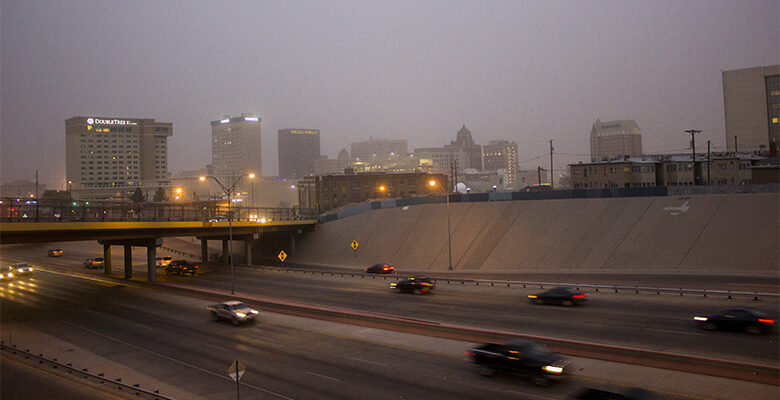
Which brings me to dirt. Climate change did not invent haboobs, and it doesn’t cause every dust storm. But this is precisely where I wish those scientists standing in front of the weather map would occasionally take another 30 seconds and explain how the pieces fit together. Hotter conditions increase evaporation. Increased evaporation helps dry the soil. Drought damages vegetation. Less vegetation exposes more soil. Then strong wind arrives, or a thunderstorm produces a powerful outflow, and suddenly a substantial portion of southern New Mexico is headed toward El Paso at 40 miles per hour.
Of course, climate isn’t the only factor. Construction disturbs soil. Agriculture affects it. Grazing affects it. Roads and development affect it. Vegetation changes affect it. Weather and climate are systems, and systems have lots of moving parts. And systems are exactly what scientists are supposed to help us understand.
Which brings me back to television meteorologists, because I don’t think their responsibility is to mention climate change every night. If there is a thunderstorm bearing down on my house, I don’t need a five-minute explanation of atmospheric carbon dioxide. I need to know whether I should bring in the patio furniture and the dog. Weather forecasting is important precisely because weather affects what we’re going to do today and tomorrow.
But surely there is room for the bigger picture occasionally, especially when another record falls. If you tell me that today was the hottest September 18 ever recorded, why not take another 20 seconds and show me what September temperatures have done over the last 50 years? If you tell me we have just finished one of the hottest summers on record, show me how recent summers compare with earlier ones. If nighttime temperatures keep setting records, explain whether nighttime temperatures have changed over time.
That’s not politics. That’s context. Make the difficult-to-understand understandable.
Climate change doesn’t create every weather event. It changes the environment in which weather happens, and I think that distinction is both simple enough and important enough for television meteorologists to explain.
Think of loaded dice. You can still roll a two and you can still roll a twelve. El Paso can still have a cold winter, a wet monsoon, a mild summer, or a year with relatively few dust storms. Natural variation hasn’t disappeared. But change the weighting of the dice and some numbers begin appearing more often, which is a pretty good way of understanding why a warming climate doesn’t mean every Tuesday has to be hotter than the Tuesday before it.
This shouldn’t be particularly controversial, but somewhere along the way climate change became political. A meteorologist can say, “We broke the record high today,” and nobody thinks twice about it. Say, “Extreme heat has become more common as the climate has warmed,” and suddenly somebody is composing an angry email to the station manager before the seven-day forecast is finished, threatening their FCC license.
Science doesn’t become less true because somebody gets mad about it. Gravity doesn’t care how you vote, carbon dioxide doesn’t check your voter registration card, and the thermometer at the El Paso airport is spectacularly uninterested in whether you watch Fox News or MSNBC.
That is why I think local meteorologists should embrace their unusual position rather than retreat from it. They have something almost every other scientist wishes they had: several minutes of airtime every day, often several times a day, with an audience that actually wants to hear what they have to say. We already trust them to explain radar, dew points, atmospheric pressure, monsoons, El Niño, and why that storm over Anthony is probably going to miss my house again. Climate shouldn’t suddenly become off-limits because somebody decided it was politically inconvenient.
Tell us what we know. Tell us what we don’t know. Tell us where the evidence is strong and where it isn’t. Tell us when an individual event cannot be attributed to climate change, but also tell us when decades of measurements show that the background conditions in which those events occur have changed. Don’t preach. Don’t campaign. Don’t tell us what political conclusions to draw from the information. Just do the science.
Because there is a strange contradiction playing out on our television screens. We hear about another record high, another warm night, another disappointing monsoon, another drought warning, another dust storm, and another year that somehow manages to rank among the hottest we have measured. Each one gets reported as a separate weather story, while the long-term change connecting many of them is treated as though mentioning it might be impolite. People won’t connect the dots unless someone helps them connect the dots.
Climate change doesn’t belong in every weather forecast. But if the records keep falling, eventually the records themselves become the story, and somebody ought to explain what that story means. El Paso has always been hot. It has always been dry, windy, and dusty. We have always had droughts, floods, miserable summers, failed monsoons, and dust storms that turn the sky brown. Nobody is arguing otherwise.
The question is whether all of those things are happening inside the same climate they happened in 50 years ago. The measurements say they aren’t.
And if the scientist standing in front of the weather map every night doesn’t explain that to us, who will? At some point we have to stop calling the weather unusual and admit something much simpler: The unusual is now usual, and you need to explain why.
Sources:
* National Weather Service El Paso — Area Climate / Climate Normals
* National Weather Service El Paso — 100-Degree Days
* National Weather Service El Paso — Historical Climate Data
* National Weather Service El Paso — 2023 Annual Climate Review
* National Weather Service El Paso — Yearly Climate Graphs
* Nature Climate Change — Southwestern North American Megadrought
* U.S. Climate Resilience Toolkit — Southwest
* NOAA Climate.gov — Dustier Summers in the Southwest
* EPA HERO — Southwest Dust and Drought Study
* American Meteorological Society — Broadcast Meteorologists’ Views on Climate Change
* American Meteorological Society — Reporting on Climate Change by Broadcast Meteorologists
* American Meteorological Society — TV Weathercasters’ Views of Climate Change* George Mason University — National Survey of Broadcast Meteorologists
* Pew Research Center — The Changing TV News Landscape
Some great stuff here, Tim! Thank you. Just the other day, my grandson, who now lives on the East Coast, asked me about when were we “scheduled” to get rain, and I had to remind him that the local prognosticators were *predicting* rain later that day, but that is not at all something that I count on. And, of course, over here in far east El Paso, near Joe Battle and Montwood, we got very little rainfall while everybody was running around seeking sandbags and worrying about flooding. It is still the desert and we still have unpredictable weather, but I think the trends are pretty clear as this article shows.
Thank you, John. I seriously doubt this little essay will suddenly prompt “Doppler” Dave and others to recognize the issue and inform their audiences about global climate change. They have known about it for decades so by now it is a choice rather than an oversight. They remain bound to sponsors—every car dealership and El Paso Electric—that add to the problem and will never acknowledge it.
Precisely!
“Climate shouldn’t suddenly become off-limits because somebody decided it was politically inconvenient.”
Precisely the problem. Too many news/weather stations don’t want to upset the ratings. Very sad
One of my followers on Facebook wrote this:
The TV weather guys know that climate change is att the heart of these changing, often violent, weather patterns. But they also know that if they mention it they will be inundated with phone calls, email, texts, etc. saying that climate change is a hoax and untrue. The easiest course to take is just don’t mention it.
So glad climate change is a hoax otherwide things would really be bad.
https://factkeepers.com/climate-change-300-glaciers-have-disappeared-from-the-american-west-since-the-mid-20th-century/